

share on
This will replace the current system of using fingerprints at land checkpoints.
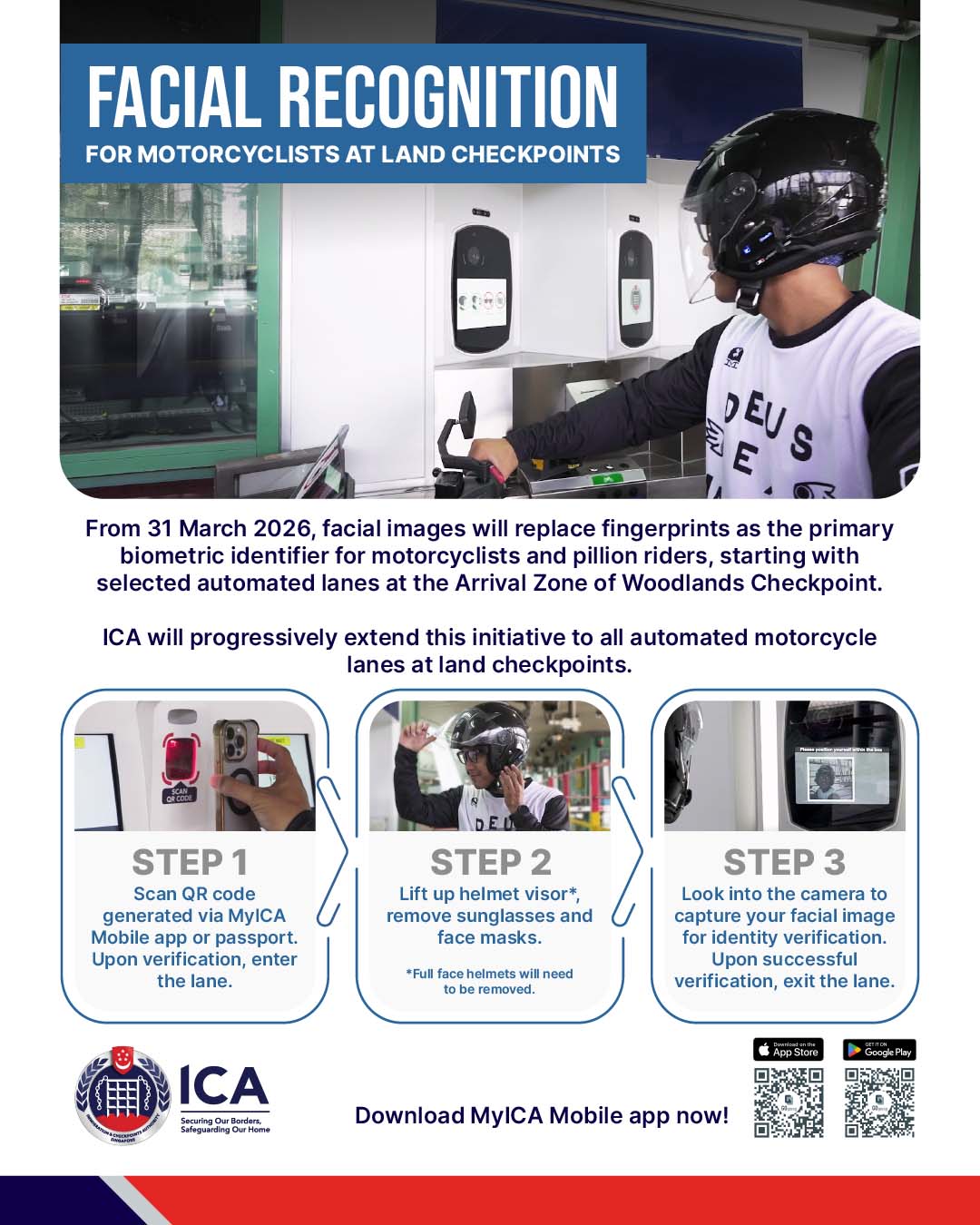
From 31 March 2026 (Tuesday), facial images will progressively replace fingerprints as the primary biometric identifier for motorcyclists and pillion riders clearing immigration at Singapore’s land checkpoints.
The move is part of the Immigration & Checkpoints Authority (ICA)’s New Clearance Concept, aimed at delivering a more contactless, secure and efficient immigration process.
Trials shape rollout at Woodlands Checkpoint
The rollout follows trials conducted since January 2026 at selected motorcycle lanes in the arrival zone of Woodlands Checkpoint.
More than 150,000 motorcyclists and pillion riders took part in these trials. ICA said feedback from users helped refine the system and improve the overall clearance experience.
Enhancements include improved detection of obstructed facial features, such as when travellers are wearing masks or sunglasses. On-screen prompts have also been introduced to guide users to remove these items before facial scanning.
Progressive implementation across checkpoints
From 31 March, facial recognition will be implemented at 18 automated motorcycle lanes in the arrival zone of Woodlands Checkpoint.
This will be progressively expanded to all 70 automated arrival and departure motorcycle lanes at the checkpoint. The initiative is also expected to extend to Tuas Checkpoint in the third quarter of 2026.
The system will be available to Singapore residents, long-term pass holders, and foreign visitors who have previously entered Singapore.
First-time foreign visitors, as well as those re-entering with a different passport, will still need to undergo manual clearance. They can use the automated lanes with facial recognition and QR codes for subsequent trips.
QR code clearance on the rise among travellers
As part of the clearance process, travellers must first present either a passport or a QR code before proceeding to biometric verification.
As of 15 March 2026, 62% of motorcyclists and pillion riders were already using QR code clearance at Singapore’s land checkpoints.
ICA is encouraging more travellers to adopt QR codes generated via the MyICA mobile application, which allows for passport-less clearance. Greater adoption is expected to improve traffic flow and reduce waiting times.
Travellers are still required to carry their passports, as officers may request them for verification. QR codes must also be updated if passport details change, or they may be rejected during clearance.
What motorcyclists and pillion riders can expect at automated lanes
According to ICA, the clearance process at automated motorcycle lanes will involve the following steps:
- Present and scan passport or QR code generated via the MyICA mobile application.
- Enter the lane once the entry barrier is raised after verification.
- Lift helmet visor and remove full-face helmets if worn to ensure full facial visibility.
- Remove sunglasses and face masks, if any.
- Look directly into the camera for facial image capture and identity verification.
- Exit the lane after the exit barrier is raised upon successful immigration clearance.
Overall, the streamlined process is expected to make immigration clearance quicker and more seamless for motorcyclists over time.
ALSO READ: PM Anwar advises private companies to implement WFH arrangements to cope with fuel costs
Infographic / Immigration & Checkpoints Authority (ICA)
share on
Follow us on Telegram and on Instagram @humanresourcesonline for all the latest HR and manpower news from around the region!
Related topics
