

share on
- ICA will roll out the next phase of its New Clearance Concept (NCC), including automated in-vehicle immigration clearance for cars, motorcycles, and cargo vehicles at land checkpoints.
- The authority is also expanding the use of AI, biometrics, and digital services to improve clearance efficiency, strengthen border security, and streamline customer services.
- Upcoming initiatives include Automated Cargo Permit Clearance (ACPC), the new Singapore Cruise Centre at HarbourFront, and the Johor Bahru–Singapore RTS Link.
The Immigration & Checkpoints Authority (ICA) is moving into the next phase of its New Clearance Concept (NCC), with plans to introduce automated in-vehicle immigration clearance for cars, motorcycles, and cargo vehicles at Singapore’s land checkpoints from early 2027.
The announcement was made during ICA’s annual Workplan Seminar on 8 May 2026, where K. Shanmugam, Coordinating Minister for National Security and Minister for Home Affairs attended as Guest-of-Honour.
The seminar outlined how ICA plans to deepen the use of automation, biometrics, and artificial intelligence (AI) to manage rising traveller volumes while strengthening border security.
According to ICA, the NCC has already transformed immigration clearance across Singapore’s air, land, and sea checkpoints. Traditionally dependent on officer-manned counters, the system now relies heavily on automated lanes supported by biometrics, pre-arrival data, and risk assessments conducted by ICA’s Integrated Targeting Centre (ITC).
ICA said automated immigration clearance has become “the norm” at Singapore’s checkpoints, adding that Singapore is likely the first country to achieve automated clearance for all travellers. Since May 2024, all foreign visitors arriving in Singapore have been able to use automated lanes without prior enrolment.
A key feature of this transformation is passport-less clearance, which allows Singapore residents and departing foreign travellers to clear immigration seamlessly through token-less clearance using only facial and iris biometrics, without presenting their passports. This has been fully implemented at Changi Airport, Seletar Airport, Marina Bay Cruise Centre, and Tanah Merah Ferry Terminal.
Meanwhile, QR code clearance using codes generated via the MyICA mobile application has been fully implemented at land checkpoints since January 2025.
In 2025, close to 127mn travellers cleared immigration without presenting their passports, representing a 270.2% increase from 2024, ICA said.
ICA also shared that facial recognition technology has progressively replaced fingerprint scanning for motorcyclists and pillion riders at Woodlands Checkpoint since 31 March 2026. The system is expected to be extended to Tuas Checkpoint in the third quarter of 2026. As of 30 April 2026, more than 1.2mn motorcyclists and pillion riders had cleared immigration using facial images.
Land checkpoints to see next round of automation
Coming to the land borders, ICA said Singapore's land checkpoints continue to handle the largest share of traveller traffic, with close to 245mn travellers cleared in 2025, an increase of 6.3% from the previous year and exceeding pre-COVID levels.
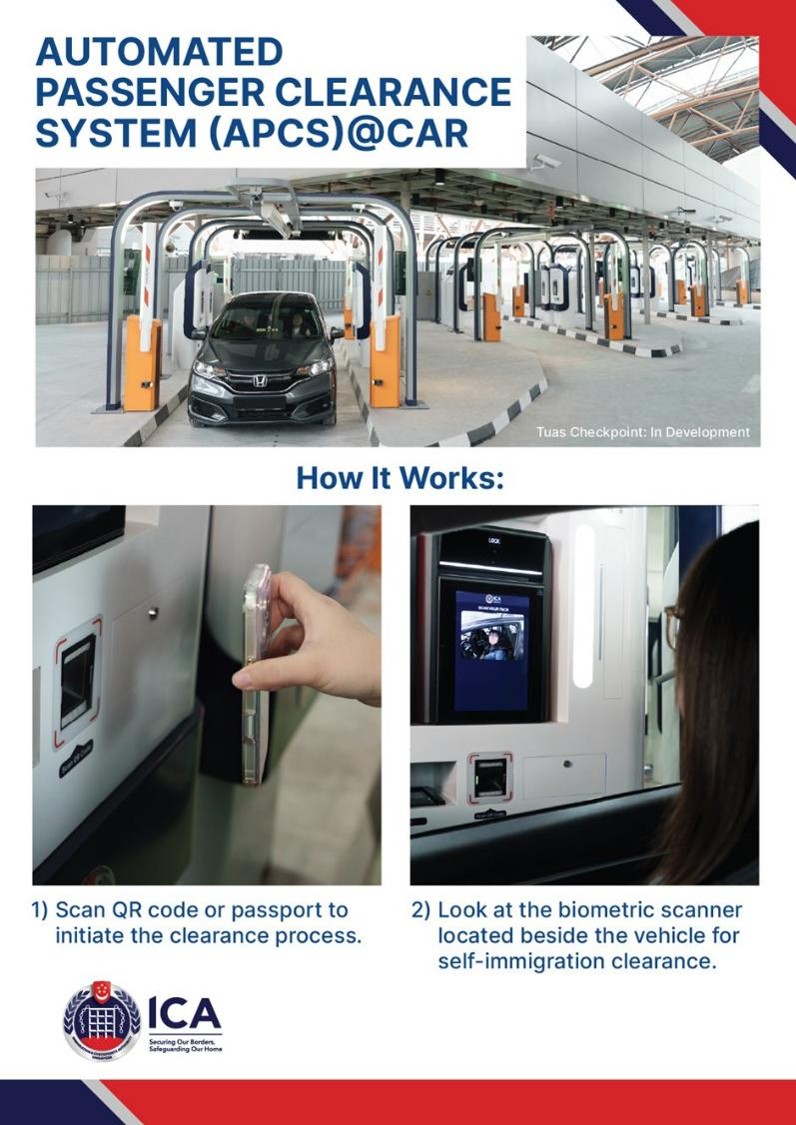
To increase clearance throughput while maintaining border security, ICA will progressively roll out the Automated Passenger Clearance System (APCS), which it said is likely the world’s first automated in-vehicle immigration clearance system for multiple travellers.
Under the system, drivers and passengers travelling in cars, motorcycles, and cargo vehicles will be able to perform self-immigration clearance without leaving their vehicles. ICA said this would help increase clearance throughput while providing a more seamless clearance experience.
According to ICA, the APCS is designed to strengthen security alongside convenience. The APCS lanes are equipped with counter-forgery capabilities and multi-modal biometric verification to enhance ICA’s ability to detect imposters and fraudulent documents.
ICA added that automation would also allow officers to be redeployed from manual clearance functions to higher-value roles such as profiling, conducting targeted interviews, and investigations, strengthening Singapore’s overall border security posture.
The APCS will also work alongside ICA’s ITC, which uses advance passenger and vehicle information together with data analytics to identify high-risk travellers, vehicles, and consignments ahead of their arrival. Cases flagged at the APCS lanes will be referred for more stringent checks, enabling more targeted and effective detections.
One of these would be APCS@Car, through which officers will be able to remotely oversee multiple lanes through a dashboard with live camera feeds, while travellers can communicate with officers via intercom systems installed at each lane. APCS@Car lanes may also be configured to clear up to two motorcycles at once, depending on operational needs and traffic conditions.
The system is expected to be progressively implemented at Tuas Checkpoint from early 2027, before being rolled out at the redeveloped Woodlands Checkpoint.
APCS for cargo vehicles will also be introduced from early 2027 at Tuas Checkpoint before expansion to Woodlands Checkpoint.
AI and digitalisation to reshape customer services
Beyond border clearance, ICA also shared plans to further digitalise its immigration and registration services under its Services Centre Next Generation (SCNG) plans, while continuing to adopt a “digital-first, but not digital only” approach.
Today, more than 95% of customers transact with ICA online or through the MyICA mobile application.
For customers who still require in-person services, the new ICA Services Centre (ISC), which opened on 31 July 2025, was introduced wil the aim to provide a more efficient and integrated customer experience through redesigned systems and processes.
One of the new features is the Appointment & Queue System (AQS), an online platform that allows customers to book appointments, receive notifications, and check in digitally before proceeding directly to their designated service rooms, reducing waiting time on-site.
ICA also highlighted its Integrated Smart Document Management System (iSMART), an automated and biometric-enabled system that allows eligible customers to collect their passports and identity cards through self-service kiosks. According to ICA, the collection process now takes around five minutes on the appointment day, compared to about 11 minutes previously.
The ISC also includes iAssist, a dedicated service area that provides in-person support for customers who face difficulties with digital transactions. ICA said officers at the centre are trained to handle multiple services, allowing for more efficient support.
The authority is also expanding the use of AI across document processing and customer services.
In collaboration with HTX, ICA developed the Multimodal AI for Text Recognition & Information eXtraction (MATRIX), an AI-driven system designed to process documents of different formats and layouts. The aim of the system is to improve data extraction accuracy by up to threefold, helping to streamline processing and reduce manual work for officers.
An AI anomaly detection initiative will also be introduced to detect irregularities in submitted documents, including potentially altered education or marriage certificates used in immigration applications.
Separately, ICA plans to trial self-service biometric enrolment kiosks, known as iEnrol, in the fourth quarter of 2026. Equipped with AI capabilities, the kiosks will allow customers to self-enrol biometrics for Permanent Residence (PR) and Long-Term Pass applications.
Security and workforce transformation remain central
In his speech at the seminar, Minister Shanmugam said ICA’s transformation efforts were aimed at balancing convenience with security, while enabling officers to focus on higher-value work.
He noted that average immigration clearance times had fallen from 25 seconds to 10 seconds under the NCC, while throughput had more than doubled, adding that ICA’s use of advanced biometrics and data analytics has contributed to a 40% increase in identifying high-risk individuals and a 30% increase in contraband detection in 2025 compared to 2024.
Minister Shanmugam also highlighted the role of technology in workforce transformation, saying officers would increasingly focus on risk assessments, handling complex casework, and managing automated systems instead of repetitive manual tasks.
In that vein, he shared: "There will be continuous upskilling programmes to equip staff with digital and AI competencies for the future. Now, there will be people that are affected in their roles, and they will receive support to adapt, to change roles and new roles."
Other upcoming initiatives and infrastructure developments
The above aside, ICA also shared updates on upcoming initiatives aimed at improving cargo clearance and cross-border connectivity.
Since March 2023, drivers and traders have been able to pre-submit vehicle and cargo permit information through the MyICA mobile application or e-Service before arriving at checkpoints, making cargo clearance almost paperless and reducing clearance time by around 30%. ICA said about 98% of drivers are currently using the system.
Building on this, ICA will progressively roll out Automated Cargo Permit Clearance (ACPC) from July 2026 across air, land, and sea cargo checkpoints. Vehicles will be automatically matched against pre-submitted cargo permit information, allowing cargo to be cleared without officers’ intervention if no anomalies are detected.
A new Singapore Cruise Centre at HarbourFront is also expected to begin operations from July 2026, featuring automated lanes and up to 25% higher passenger clearance capacity.
Meanwhile, the Johor Bahru–Singapore Rapid Transit System (RTS) Link is expected to commence operations by end-December 2026, allowing travellers to complete immigration clearance only at the point of departure through co-located clearance facilities in Singapore and Malaysia.
Over the next 10 to 15 years, Woodlands Checkpoint will also be redeveloped and expanded in phases to improve congestion and clearance efficiency.
ICA concluded: “As ICA moves on to the next chapter of our transformation journey, we will continue to leverage innovation and technology to deliver secure, seamless and efficient immigration clearance while keeping Singapore’s borders safe and secure.”
ALSO READ: Malaysia to enhance MyKad security features in June, fully roll out MyNIISe in September
Photos / ICA
share on
Follow us on Telegram and on Instagram @humanresourcesonline for all the latest HR and manpower news from around the region!
Related topics
