

share on
The NSAS will focus on advancing space capabilities through various mandates, such as developing and operating Singapore’s national space capabilities, strengthening Singapore’s R&D ecosystem, and more.
Singapore has officially established the National Space Agency of Singapore (NSAS) on 1 April, according to schedule and in line with the Ministry of Trade and Industry (MTI) Singapore's planned timeline.
In a LinkedIn post on 1 April 2026, the agency said it aims to "provide decisive leadership for Singapore to seize opportunities in the expanding space economy and the new possibilities posed by democratised access to outer space."
With a mission to advance space capabilities to strengthen how Singapore and the world live, move, connect and thrive, NSAS will take on the following mandates and functions:
- Develop and operate Singapore’s national space capabilities
- Strengthen Singapore’s R&D ecosystem
- Develop Singapore’s space industry
- Advance international partnerships
- Develop legislation and regulations which are pro-innovation and pro-business while achieving space safety and sustainability
NSAS cited Singapore as a global hub with strong foundations in space-adjacent sectors such as aerospace, microelectronics, precision engineering and artificial intelligence, highlighting that the country is well placed to capitalise on global momentum in the space sector. This includes the use of space technologies to enhance communications and connectivity services, as well as to drive innovation in the green and digital economy, therefore strengthening Singapore’s business competitiveness.
NSAS is thus well positioned to spearhead Singapore’s national space ambitions — not only at the consumer level, but as a credible contributor to the global space ecosystem.
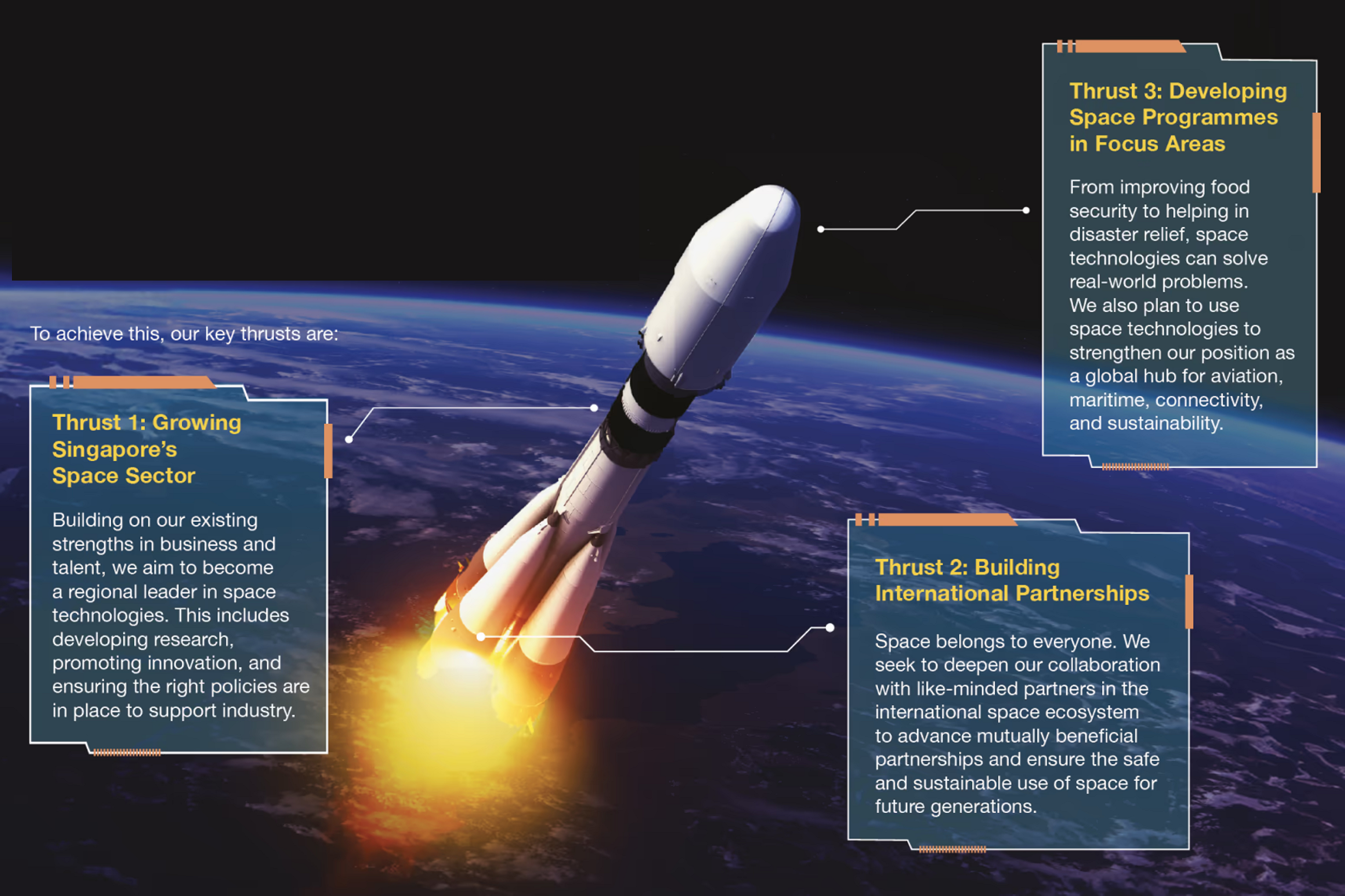
Building on this, Singapore’s Space Sector: Next Bound of Development, introduced on 26 February 2026, sets out the next stage of Singapore’s space journey. Together, the Office for Space Technology & Industry (OSTIn) and the newly established NSAS will amplify Singapore’s efforts to harness the potential of space technologies and unlock new opportunities in the space economy. This will be driven through three key thrusts:
This is said to be done in three thrusts:
- Growing Singapore's space sector
- Building international partnerships
- Developing space programmes in focus areas
For businesses, this means Singapore welcomes local and international space companies to collaborate, the agency said. "Singapore is ready to support innovation in space technology, and we can help your business to succeed by facilitating access to Singapore’s R&D ecosystem, our skilled talent pool, and our regional network."
For Singaporeans, it cited the space industry as an exciting field. "Whether you are passionate about technology, engineering, or sustainability, space offers endless opportunities to innovate and make a difference. We encourage you to discover the limitless possibilities of space and consider a future in the space industry."
In a Telegram update, Prime Minister Lawrence Wong highlighted that the global space industry is growing rapidly, and despite not having launch sites or vast land, Singapore has "real strengths in specialised areas."
"We can be a high-value, innovation-driven space hub — focused on satellites, data, high-end manufacturing and services," he affirmed.
"Space technologies can also help us overcome our physical constraints — from improving connectivity, to enhancing climate monitoring and disaster response."
PM Wong elaborated that the new agency will bring together expertise across government, industry and academia to seize these opportunities, and strengthen Singapore’s resilience for the future.
Background
As shared by MTI in February this year, Singapore is home to about 70 space companies, employing around 2,000 professionals in diverse roles and activities across the value chain, from designing and manufacturing space components to providing satellite-based services.
Looking ahead, the NSAS will spearhead Singapore's efforts to fully harness the value and opportunities of the growing global space economy, which is projected to reach US$1.8tn by 2035.
Complementing NSAS’ role, Singapore has also built a network of international partnerships with key space agencies, including the European Space Agency, the Indian National Space Promotion and Authorization Centre (IN-SPACe), the UAE Space Agency, and Thailand’s Geo-Informatics and Space Technology Development Agency.
The establishment of NSAS is thus said to represent Singapore's commitment to become a leader in space technologies and services, leveraging its strategic location, technological capabilities, and business-friendly environment to capture emerging opportunities in the global space economy.
READ MORE: ITE and BDx Data Centers partner on talent development for Singapore's digital infrastructure sector
Lead image / PM Wong's Telegram
share on
